MGNREGA – Mahatma Gandhi National Rural Employment Guarantee Act
The Mahatma Gandhi National Rural Employment Guarantee Act (MGNREGA) — formerly known as the National Rural Employment Guarantee Act (NREGA) — is one of India’s most significant social welfare initiatives. Enacted in 2005 and implemented in 2006 by the Ministry of Rural Development, Government of India, the scheme guarantees at least 100 days of wage employment every financial year to rural households whose adult members are willing to undertake unskilled manual labour.
MGNREGA aims to enhance livelihood security, reduce rural poverty, and strengthen grassroots governance through the active participation of Gram Panchayats. The programme operates across India, covering all districts except those with a completely urban population.
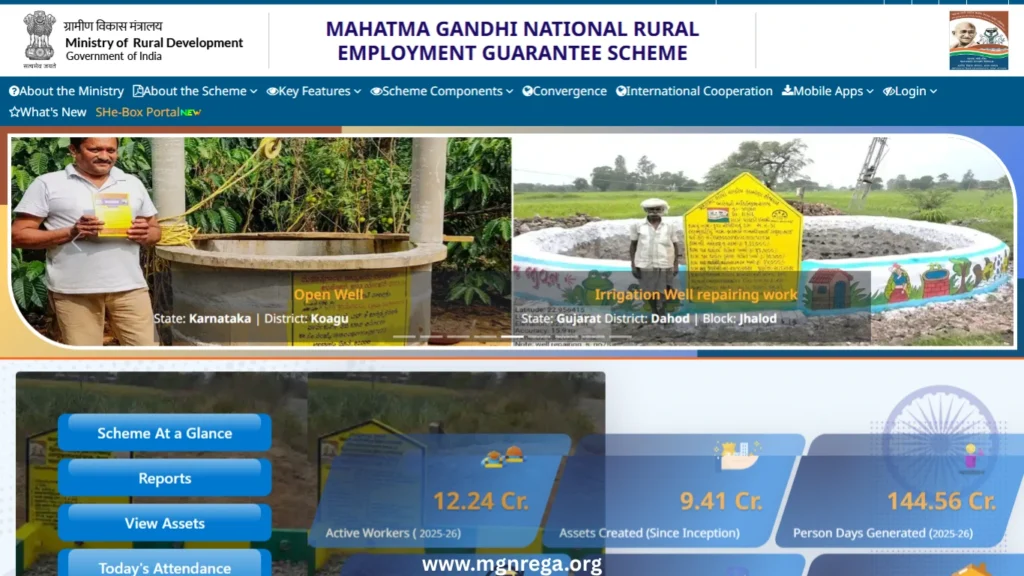
Overview of MGNREGA
| Particular | Details |
|---|---|
| Full Name | Mahatma Gandhi National Rural Employment Guarantee Act (MGNREGA) |
| Also Known As | National Rural Employment Guarantee Act (NREGA) |
| Launched | 2006 |
| Ministry | Ministry of Rural Development, Government of India |
| Beneficiaries | Rural households with adult members willing to do unskilled work |
| Employment Guarantee | 100 days per financial year |
| Coverage | All rural districts (except those with 100% urban population) |
| Wage Payment Mode | Direct transfer to Bank/Post Office Account |
| Key Features | Equal wages for men and women, transparency, and local work availability |
What is MGNREGA?
The Mahatma Gandhi National Rural Employment Guarantee Act (MGNREGA), enacted in 2005, is a rights-based employment programme that guarantees at least 100 days of wage employment every financial year to rural households whose adult members are willing to perform unskilled manual work. It empowers citizens to demand work through their Gram Panchayat, making employment a legal right rather than a welfare benefit.
The scheme operates across rural India, ensuring livelihood security while promoting economic empowerment and social inclusion. It also contributes to rural development through the creation of durable community assets like roads, ponds, and irrigation facilities.
Objectives of MGNREGA
The Mahatma Gandhi National Rural Employment Guarantee Act (MGNREGA) aims to enhance livelihood security in rural areas by guaranteeing wage employment and promoting inclusive growth. The scheme focuses on sustainable development through asset creation, empowerment, and transparency in local governance.
Key Objectives:
- To provide livelihood security to rural households through guaranteed employment.
- To create durable rural assets such as ponds, roads, canals, and wells.
- To promote economic inclusion for marginalized groups, including women, SC/ST, and persons with disabilities.
- To strengthen Gram Panchayats through decentralized planning and implementation.
- To ensure transparency and accountability through social audits and community participation.
Key Features of the MGNREGA Scheme
- 100 Days of Work: Each eligible rural household is guaranteed up to 100 days of wage employment in a year.
- Time-bound Employment: Job must be provided within 15 days of application; otherwise, the applicant is entitled to unemployment allowance.
- Equal Pay: Men and women receive equal wages under the Act.
- Local Employment: Work should be provided within 5 km of the applicant’s residence; if farther, workers receive travel and subsistence allowance.
- Direct Benefit Transfer (DBT): Wages are credited directly into the bank or post office account of workers.
- Transparency: All records are maintained through the MGNREGA MIS Report (NREGASoft), and social audits are conducted at the Gram Panchayat level.
- Inclusivity: Special provisions exist for persons with disabilities, senior citizens, and internally displaced persons.
Who is Eligible for MGNREGA?
Eligibility under the Mahatma Gandhi National Rural Employment Guarantee Act (MGNREGA) is simple and inclusive. Any Indian citizen who meets the following criteria can apply for a Job Card under the scheme.
| Criteria | Requirement |
|---|---|
| Citizenship | Applicant must be an Indian citizen. |
| Age | Applicant must be 18 years of age or older. |
| Residence | Applicant must reside in a rural area. |
| Willingness to Work | Applicant must be willing to perform unskilled manual labour. |
There are no income or caste-based restrictions, making MGNREGA one of India’s most inclusive and accessible rural employment programmes.
What is a Job Card under MGNREGA?
A Job Card (JC) is a vital document issued under the Mahatma Gandhi National Rural Employment Guarantee Act (MGNREGA). It acts as both an identity card and proof of registration for rural households seeking employment under the scheme.
Key Details Mentioned on a Job Card:
- Name, age, and gender of all adult household members
- Unique Job Card Number (JC ID)
- Name and address of the Gram Panchayat
- Record of employment provided and wages paid
- Photographs of all registered cardholders
The Gram Panchayat issues the Job Card free of cost within 15 days of application. Once issued, cardholders can use it to apply for work, track attendance, and verify wage payments online through the official MGNREGA Management Information System (MIS).
How to Apply for MGNREGA Job Card
Under the Mahatma Gandhi National Rural Employment Guarantee Act (MGNREGA), every rural household must possess a valid Job Card (JC) to avail employment benefits. You can apply for a Job Card offline through your Gram Panchayat or online via official government platforms.
Offline Application Process
- Submit an Application:
Visit your local Gram Panchayat office and submit a written or oral request for registration. You can also speak to the Panchayat Secretary or Gram Rozgar Sahayak (GRS), who will record your details. - Provide Required Details:
Include information such as your name, age, gender, Aadhaar number, caste (SC/ST/OBC), and bank/post office account number. - Verification:
The Gram Panchayat verifies your details and confirms whether you are a local resident and an adult member of your household. The process is completed within 15 days of application submission. - Issuance of Job Card:
If eligible, your Job Card (JC) is issued within 15 days and handed over in the presence of local residents to ensure transparency.
🕒 Applications are open throughout the year at Gram Panchayat offices.
Online Application Process
You can also apply for an MGNREGA Job Card online using official platforms like the Common Service Centres (CSCs) or the UMANG App.
Option 1: Through CSC (Common Service Centre)
- Visit your nearest CSC centre.
- The operator will fill out your application form and forward it to the Gram Panchayat for verification.
- After approval, your Job Card will be issued within 15 days.
Option 2: Through UMANG App or Website
- Download the UMANG App or visit web.umang.gov.in.
- Log in using your mobile number and OTP.
- Search for “MGNREGA” and select “Apply for Job Card.”
- Fill in your personal details, upload your photo, select the mode of payment, and click Submit.
- Your application will be forwarded to the Gram Panchayat for verification and approval.
Documents Required for MGNREGA Job Card Application
To apply for an MGNREGA Job Card, applicants must provide the following documents during the registration process:
- Recent Passport-Size Photograph:
A clear and recent photo of the applicant for identification purposes. - Proof of Identity:
Any one of the following documents — Aadhaar Card, Voter ID, Ration Card, or PAN Card — to verify the applicant’s identity. - Proof of Residence:
Valid proof showing the applicant’s village, block, or Gram Panchayat residence (such as electricity bill, residence certificate, or ration card). - Bank or Post Office Account Details:
Account number and IFSC code are required to ensure direct transfer of wages under the MGNREGA scheme.
Note: All submitted documents must be self-attested and verified by the Gram Panchayat Secretary or Gram Rozgar Sahayak (GRS) during the application process.
Payment and Wages under MGNREGA
Under the Mahatma Gandhi National Rural Employment Guarantee Act (MGNREGA), workers receive wages directly in their bank or post office accounts through the Direct Benefit Transfer (DBT) system. This ensures complete transparency and eliminates middlemen.
Wages are required to be paid within 15 days of completing the work. Both men and women are entitled to equal pay. If work is not provided within 15 days of applying, the applicant becomes eligible for an unemployment allowance. Additionally, if the worksite is located more than 5 km from the worker’s residence, they receive travel and subsistence allowances.
Workers can check their payment details, attendance, and muster rolls online through the MGNREGA MIS (Management Information System).
MGNREGA Payment Details and MIS Reports
The MGNREGA payment system is completely digital to promote transparency. Every payment, muster roll, and report is available publicly through the NREGASoft portal.
Key Payment Highlights
- Wages are transferred via DBT directly to workers’ accounts.
- Payment is based on daily attendance (NMMS app) and government-notified wage rates.
- Workers can check their payment status on the MGNREGA MIS portal for their respective state.
- In case of payment delays, the government pays interest as compensation.
MGNREGA MIS Report
The MIS (Management Information System) offers real-time data on:
- Job card registrations
- Work allocation and project progress
- Wage payments and expenditure
- Assets created under MGNREGA
You can access these reports online via your state MGNREGA website or the official NREGASoft dashboard at nregastrep.nic.in.
How to Check MGNREGA Payment Details Online
- Visit your state’s MGNREGA portal.
- Open the “Payment Details” section.
- Enter your Job Card Number or Gram Panchayat name.
- The portal displays payment date, amount, and status.
All payments are directly credited to the worker’s bank or post office account, ensuring complete transparency.
MGNREGA Attendance (NMMS and Muster Roll)
Attendance under MGNREGA is now recorded digitally through the National Mobile Monitoring System (NMMS) App, which captures real-time attendance with geo-tagged photos to prevent fraud.
| Type | Description |
|---|---|
| Manual Muster Roll | Traditional paper-based attendance record |
| NMMS Attendance | Captured via the NMMS App with real-time verification |
| Daily Attendance Report | Available on the state MGNREGA portals |
This system ensures accuracy, transparency, and accountability in wage payments.
Types of Works under MGNREGA
More than 260 types of rural development projects are approved under the scheme, broadly classified into:
- Water conservation and irrigation works
- Rural road and drainage construction
- Afforestation and land development
- Flood control and drought proofing
- Community assets for Self-Help Groups (SHGs) and public institutions
Bhuvan MGNREGA Portal
The Bhuvan MGNREGA platform, developed by ISRO (Indian Space Research Organisation), allows users to view geo-tagged assets created under the scheme. This satellite-based system enhances monitoring and transparency of rural works.
Special Provisions under MGNREGA
1. For Women
- At least one-third of total beneficiaries must be women.
- States like Kerala, Tamil Nadu, and Puducherry report over 80% women participation.
- Equal wages are guaranteed for both genders.
2. For Persons with Disabilities
- Provision of suitable work types and modified tools.
- Priority employment for lighter duties such as caretaking or water management.
3. For Senior Citizens
- Allocation of less strenuous work.
- Formation of senior citizen-specific workgroups.
4. For Internally Displaced Persons (IDPs)
- Issuance of temporary job cards during displacement periods.
MGNREGA Wages 2026 – State-wise Rates
Wages under MGNREGA are revised annually by the Government of India and differ by state to reflect local cost of living.
| State / UT | Wage Rate (₹/Day – 2026) |
|---|---|
| Haryana | ₹355 |
| Kerala | ₹330 |
| Tamil Nadu | ₹280 |
| Uttar Pradesh | ₹230 |
| Bihar | ₹225 |
| Madhya Pradesh | ₹220 |
| Odisha | ₹228 |
| Chhattisgarh | ₹225 |
| Rajasthan | ₹255 |
| Assam | ₹230 |
(Rates as per 2025 MGNREGA wage notification by the Ministry of Rural Development.)
Funding and Implementation
- Central Government: Covers 100% of unskilled labour cost and 75% of material cost.
- State Governments: Bear 25% of material and administrative expenses.
- Funds are released through the Public Financial Management System (PFMS) to ensure timely wage payments.
Women Empowerment under MGNREGA
MGNREGA has been a powerful tool for women’s economic empowerment in rural India. It ensures equal pay and encourages participation through programs like Mahila Mates, where women take on supervisory roles at worksites.
Impact and Performance of MGNREGA
MGNREGA has made a remarkable impact on rural India since its launch in 2005. It has provided millions of rural households with employment opportunities, reducing distress migration and strengthening the rural economy. By guaranteeing 100 days of wage work, the scheme ensures a steady income for vulnerable families, especially during agricultural off-seasons.
One of its biggest achievements is the empowerment of rural women. With nearly half of all workers being women, MGNREGA has promoted gender equality and financial independence. Women are now contributing directly to household income and participating in community development works.
The program has also improved rural infrastructure through the creation of durable assets like roads, ponds, check dams, and irrigation facilities. These projects not only provide immediate employment but also enhance agricultural productivity and water conservation in the long term.
In terms of scale, MGNREGA covers over 700 districts, thousands of Gram Panchayats, and engages more than 10 crore workers annually. Transparency has improved through online record-keeping and Aadhaar-linked payments, reducing corruption and ensuring timely wage disbursal.
Overall, MGNREGA has proven to be a powerful tool for poverty reduction, social inclusion, and sustainable rural development — bridging the gap between welfare and empowerment in India’s villages.
State-Wise Performance Highlights
Some states have performed exceptionally well in implementing MGNREGA:
| State | Key Achievements |
|---|---|
| Rajasthan | High person-days generation and effective social audits |
| Chhattisgarh | Strong Gram Panchayat participation and timely payments |
| Mizoram | Successful inclusion of women and tribal households |
| Kerala | Over 85% women participation and sustainable asset creation |
| Tamil Nadu | Efficient digital attendance and wage disbursement systems |
These examples show that effective governance and community involvement greatly improve MGNREGA outcomes.